Flowmeters play a crucial role in measuring liquid flow rates, spanning applications from water treatment to oil and gas. The two most common types are in-line flowmeters and clamp-on flowmeters. While both serve the same basic purpose, they differ significantly in terms of installation, accuracy, cost, and application suitability.
What Are In-line Flowmeters and Clamp-on Flowmeters?
In-line Flowmeters
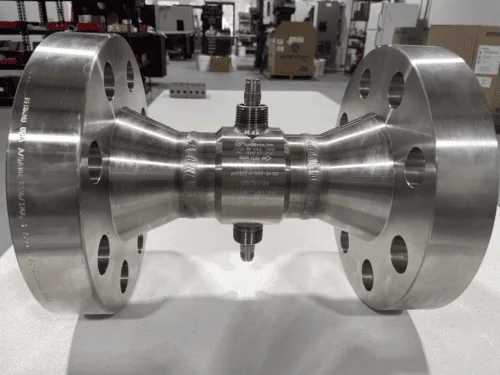
In-line flowmeters are installed directly inside the pipeline, requiring pipe cutting and meter fitting. These flowmeters are available in various technologies—such as turbine, electromagnetic, ultrasonic, and Coriolis—depending on the specific application and fluid type.
Clamp-on Flowmeters
Clamp-on flowmeters use ultrasonic sensors attached externally to the pipeline. They measure flow by transmitting and receiving sound waves through the fluid. Since they do not require direct contact with the liquid, installation is non-invasive and eliminates the need for pipe cutting.
Advantages and Disadvantages of In-line Flowmeters
Advantages of In-line Flowmeters
1. High accuracy: Direct contact with the fluid ensures precise and consistent measurements with minimal interference.
2. Versatile technology options: Available in multiple types (e.g., turbine, magnetic, Coriolis, and positive displacement), making them suitable for various industries.
3. Suitable for low-flow measurement: More effective than clamp-on flowmeters for low-flow applications, especially in the chemical and pharmaceutical industries.
4. Long-term durability: Typically constructed with robust materials to withstand harsh environments, extreme temperatures, and high pressures.
Disadvantages of In-line Flowmeters
1. Complex installation: Requires pipe cutting, operational shutdowns, and potential infrastructure modifications, increasing downtime and labor costs.
2. Higher maintenance requirements: Depending on the meter type, in-line models may need regular cleaning and calibration—especially in applications with dirty or corrosive fluids.
3. Higher upfront costs: Professional installation and potential system modifications can make them more expensive than clamp-on alternatives.
Advantages and Disadvantages of Clamp-on Flowmeters
Advantages of Clamp-on Flowmeters
Non-invasive installation: Easily attached to the outside of the pipeline, eliminating the need for system shutdowns or pipeline modifications.
Cost-effective solution: Reduced labor costs and extremely short installation time make it a more economical choice, especially for temporary or portable flow measurement.
Ideal for hard-to-reach locations: Suitable for applications where in-line installation is impractical or overly disruptive.
Low maintenance: Since they do not come into contact with the fluid, they are less prone to wear, corrosion, and clogging.
Disadvantages of Clamp-on Flowmeters
Lower accuracy compared to in-line meters: External installation may lead to measurement discrepancies, especially in pipelines with irregular flow conditions or varying liquid compositions.
Limited performance with small pipes: Clamp-on meters are most suitable for medium to large-diameter pipelines; their accuracy decreases for smaller pipe sizes.
Dependence on pipeline material and condition: Performance may be affected by pipe thickness, material, and surface condition, potentially requiring adjustments or additional calibration.
Which Flowmeter Is Suitable for Your Application?
Choose an In-line Flowmeter When:
High-precision measurement is required.
The application involves low flow rates or viscous fluids.
A solution for long-term stable operation in harsh industrial environments is needed.
Downtime caused by installation and maintenance is not a major concern.
Choose a Clamp-on Flowmeter When:
Fast, non-invasive installation without production shutdown is required.
The application involves temporary, portable, or retrofitted flow measurement needs.
Cost-effectiveness and ease of maintenance are top priorities.
The system includes large-diameter pipelines that are difficult to modify.
Summary
In-line and clamp-on flowmeters each have their own advantages and disadvantages. The best choice depends on your specific needs, including accuracy requirements, budget, installation feasibility, and long-term maintenance considerations. If the application requires high precision and reliability, an in-line flowmeter may be the better option; however, if you need a flexible and non-invasive solution, a clamp-on flowmeter can offer significant advantages.
Still unsure? Consult the flowmeter experts at Gurui Da Automation for a tailored optimal solution.













 Consultation Tel.
 Product Center
 Solution
 Home
Home