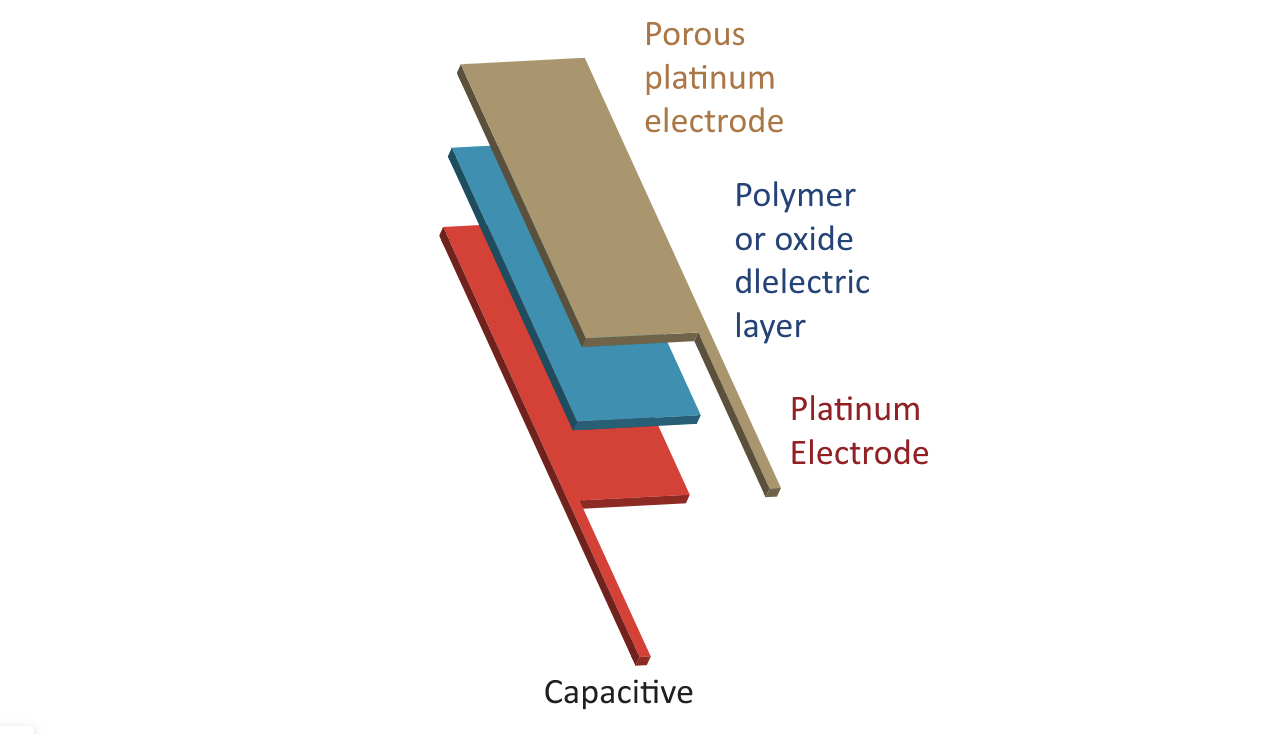
Capacitive humidity sensors consist of a hygroscopic dielectric material placed between a pair of electrodes, which form a small capacitor. Most capacitive sensors use plastics or polymers as the dielectric material, with a typical dielectric constant ranging from 2 to 15. When there is no moisture in the sensor, this constant and the geometry of the sensor determine the value of the capacitance. At normal room temperature, the dielectric constant of water vapor is approximately 80, a value much larger than that of the sensor's dielectric material. Therefore, the absorption of water vapor by the sensor causes an increase in the sensor's capacitance. Under equilibrium conditions, the amount of moisture in the hygroscopic material depends on the ambient temperature and the ambient water vapor pressure. The same is true for the hygroscopic dielectric material used in the sensor.
By definition, relative humidity is also a function of ambient temperature and water vapor pressure. Therefore, there is a relationship among relative humidity, the moisture content in the sensor, and the sensor capacitance. This relationship is the basis for the operation of capacitive humidity instruments.
In capacitive instruments, like almost all other types of instruments, humidity is measured through a chain process rather than directly. The instrument performance is determined by all elements in the chain, not just the sensor. Since the sensor and the associated electronics cannot be considered separately, any factor that interferes with the chain measurement process will inevitably affect the instrument performance.
Application Considerations - Capacitive Humidity Sensors
Newer humidity measurement technologies, such as the HYGROMER IN - 1 capacitive humidity sensor, have higher accuracy than the wet - and - dry - bulb technology and offer superior control characteristics over a wide range of temperatures and humidities.
Selecting a sensor technology compatible with a specific application is crucial for achieving reliable, repeatable, and accurate measurements.
电子式湿度传感器
Advantages and Disadvantages of Capacitive Humidity Sensors:
Advantages:
· Wide measurement range
· Wide temperature range
· Excellent stability
· Fast response speed
· Complete recovery from condensation
· Extremely strong resistance to chemicals
· Small size
· Low cost
· Minimal maintenance required
Disadvantages:
· Can be limited by the distance from the sensor to the electronics
· Relative accuracy loss below 5% RH
· Requires electronics to convert capacitance to relative humidity
Classification of Errors in Capacitive Humidity Sensors
Systematic errors are predictable and repeatable in both magnitude and sign. Errors caused by the non - linearity of the instrument or temperature effects fall into this category. Systematic errors are specific to the instrument.
Random errors depend on factors external to the instrument. This means that while systematic errors are predictable and repeatable, random errors are not. For example, errors caused by sensor hysteresis (which we will define below), as well as errors caused by the calibration process, are random errors. Usually, random errors are estimated based on statistics, experience, and judgment.
Linearity Errors
The typical response of a relative humidity sensor (between 0 and 100% RH) is non - linear. Depending on the corrective effect of the electronic circuit, the instrument may have a linearity error. Assuming that both the sensor and the associated electronics have reproducible characteristics, the linearity error is a systematic error.
Note: Careless selection of calibration values may lead to a different distribution of linearity errors and may adversely affect the instrument accuracy!
Usually, the calibration values recommended by the instrument manufacturer are determined to minimize linearity errors. Calibrating at these values should result in a uniform positive - negative distribution of linearity errors.
Temperature Errors
Temperature can have a major impact on several elements of the measurement chain process described earlier. In the specific case of capacitive humidity instruments, the following effects may cause temperature errors. The hygroscopic properties of the sensor change with temperature. Relative humidity instruments rely on the assumption that the relationship between the amount of moisture present in the sensor's hygroscopic material and relative humidity is constant. However, in most hygroscopic materials, this relationship changes with temperature. In addition, the dielectric properties of water molecules are affected by temperature. At 20°C, the dielectric value of water is approximately 80. At 0°C, this constant increases by more than 8%, and at 100°C, it decreases by 30%. The dielectric characteristics of the sensor also change with temperature.
The dielectric constant of most dielectric materials decreases as the temperature increases. Fortunately, the effect of temperature on the dielectric properties of most plastics is usually more limited than that of water.
Any length of cable connecting the sensor to the electronic circuit has its own capacitance and resistance. The electronic circuit cannot distinguish between the sensor and its connecting cable. Therefore, since the capacitance of the sensor and the cable can change with temperature, the humidity value reported by the electronics must compensate for the effect of temperature. Failure to do so may result in large measurement errors, sometimes up to 8% rh or higher.
Hysteresis
Hysteresis is the maximum difference that can be measured between corresponding data pairs obtained by running sequences of rising and falling humidity conditions. Hysteresis determines the repeatability of a humidity instrument.
For any given instrument, the hysteresis value depends on the following:
· The total span of the humidity cycle used to measure hysteresis
· The exposure time of the sensor to each humidity condition
· The temperature during the measurement
· The criteria used to determine sensor equilibrium
· And the previous sensor history
Usually, when the sensor is exposed to high humidity and high temperature for a long time, the sensor hysteresis increases.
Note: Temperature changes the capacitance of the sensor and the cable. The humidity value reported by the electronic components must compensate for the effect of temperature on the sensor.
The hysteresis value of a sensor is meaningful only when the details of the test are provided at the same time. In actual measurement practice, the conditions are extremely different, and the hysteresis may or may not reach the maximum value. Therefore, it is reasonable to consider hysteresis as a random value that cannot be fully predicted or compensated. When the instrument accuracy is certain, half of the maximum hysteresis value should be evenly distributed as positive and negative errors. However, the repeatability of the instrument should not be specified as less than the full value of the hysteresis.
Calibration Errors
Calibration involves comparing the output of a measuring instrument with a reference value and reporting the result. Adjustment involves changing the output of the instrument being calibrated to match the output of the reference value. In some cases, the service named "calibration" includes both calibration and adjustment.
The reference instruments used to provide known humidity and temperature values for calibration have their own accuracy, repeatability, and hysteresis values, which must be considered when specifying the final instrument uncertainty. In addition, any adjustments made during the calibration service cannot fully replicate the values seen by the reference instrument. These errors must be considered as random errors when calculating the instrument uncertainty.
Long - term Stability
A key factor is the instrument's ability to return the same RH value over a long period under a given humidity condition. This value is usually called repeatability and measures the instrument's ability to maintain calibration in the face of long - term changes in the characteristics of the sensor and its associated electronics. Generally, repeatability issues can be divided into two aspects: the sensor's ability to maintain its response to a given humidity state at a given temperature and the stability of the electronics.
Please note:
· Long - term stability plays a crucial role in the calibration frequency required for humidity instruments.
· The stability of the instrument significantly affects the value of the measurement data received from the instrument.
Chemical Resistance
Capacitive polymer humidity sensors are very sensitive to the presence of chemicals in the surrounding gas, and the degree of influence depends on several parameters:
· Chemical type
· Concentration
· Duration of exposure
· Humidity and temperature
· And the presence of other chemicals
Since it is difficult to predict the sensor's deviation and lifespan, it is best to conduct tests between calibration cycles.
Non - critical Chemicals
The following table illustrates the effects of these gases on the Rotronic IN - 1 series sensors:
· Argon (Ar)
· Carbon dioxide (CO2)
· Helium (He)
· Hydrogen (H2)
· Neon (Ne)
· Nitrogen (N2)
· Nitrous oxide (Laughing gas, N2O)
· Oxygen (O2)
The following gases have little or no effect on the sensor and humidity measurement:
· Butane (C4H10)
· Ethane (C2H6)
· Methane (CH4)
· Natural gas
· Propane (C3H8)
Critical Chemicals
At the following concentrations, the gases listed in the table below have little or no effect on the sensor or humidity measurement. The data shown are only guiding values, and the resistance of the sensor depends to a large extent on temperature and humidity conditions as well as the length of exposure to the contaminants.
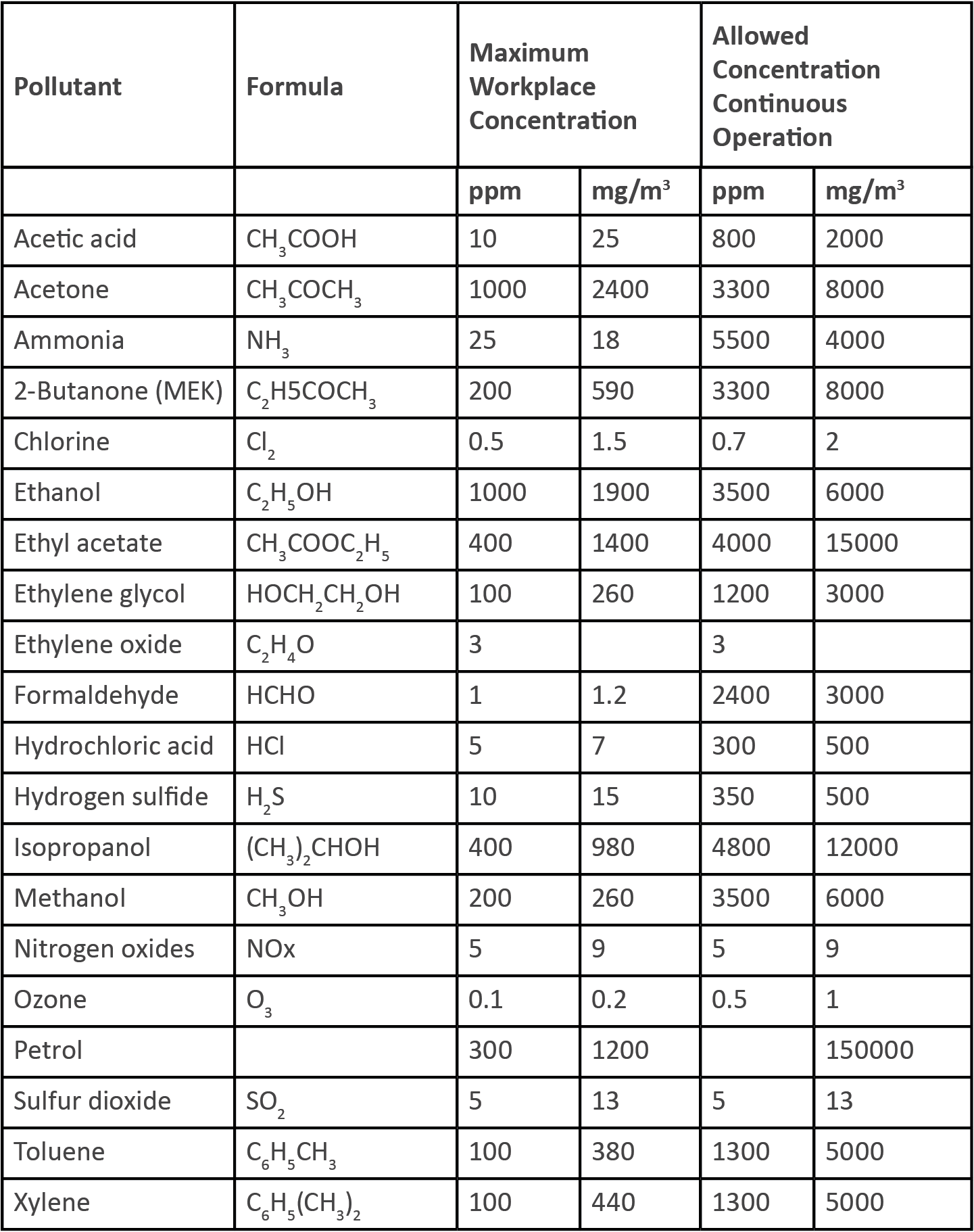
Permissible malfunctions caused by contaminants: ±2% rh
Application Examples
A) Humidity measurement in a sterilization chamber (ethylene oxide)
Customer application: Sterilization of medical devices
Sensor: C - 94
Concentration: Ethylene oxide: 15% by volume
Carbon dioxide: 85% by volume
Pressure: 0.2 to 2.5 bar absolute
Temperature: 40°C
Humidity: 80% relative humidity
Application experience: The sensor has a service life of approximately 3 months. The chamber is in continuous operation.
B) Humidity measurement in an ozone chamber
Sensor: Hygrometer HT - 1
Concentration of ozone: 500 ppm
Temperature: 23°C
Humidity: 50% relative humidity
Application experience: At 500 ppm of ozone, the sensor has a lifespan of about 1 month.
C) Special application: Humidity measurement in oil
In principle, it is possible to measure humidity directly in oil, but the service life of the sensor depends to a large extent on the oil used. Measurements in oil can only be carried out using special sensors, and tests are planned.













 Consultation Tel.
 Product Center
 Solution
 Home
Home