Wet - and dry - bulb temperature measurements are common and widely accepted techniques for controlling relative humidity in environmental chambers. ASTM Standard E 337 - 02 (2007) provides a detailed review of wet - and dry - bulb technologies. According to this standard, in a ventilated dry - and wet - bulb device, an accuracy typically within the range of 2% to 5% can be expected.
In an environmental chamber where both temperature stability and uniformity are specified to be within 1 degree Celsius, the accuracy typically achieved by a ventilated wet - and dry - bulb device is acceptable. This is because an uncertainty of 1 degree Celsius in temperature at 95% confidence with k = 2 automatically results in an uncertainty of 5 to 6% rh at high humidity at 95% confidence with k = 2. However, some chambers specified to be within 0.3 - 0.5°C allow for and require better humidity control.
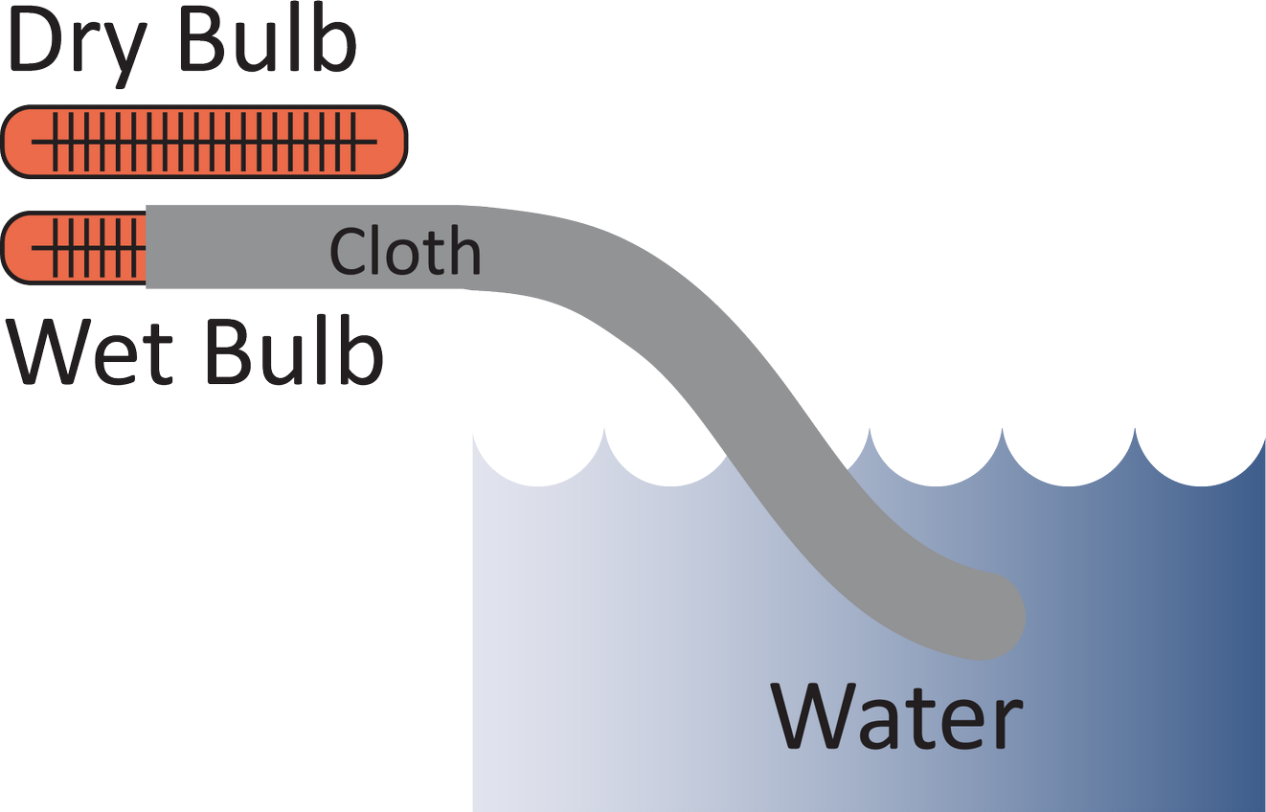
Advantages and Disadvantages of the Technology
Although the wet - and - dry - bulb measurement technology has a sound theoretical basis, the problem is that it only appears simple, leading many users to abandon the caution and precision required to obtain accurate results. We will explore the most common overlooked requirements and other issues below.
Advantages:
· Simple and fundamental measurement
· Low cost
· Good stability if operated correctly and consistently
· Tolerates condensation without damage
Disadvantages:
· High uncertainty
· Requires training and skills for use and maintenance
· Results must be calculated
· Requires a large air sample
· The process adds water vapor to the sample
· Many variables lead to increased uncertainty
Ignoring the Basic Requirements of the Technology
In practice, there is a tendency to overlook some of the following requirements of the wet - and - dry - bulb technology:
Thermometer Coefficient: This is used to establish the thermometer chart for converting the temperature readings of the wet - and dry - bulbs into relative humidity. The coefficient must be determined for each specific thermometer design, especially that of the wet - bulb.
Atmospheric Pressure: The atmospheric pressure chart is usually valid at "standard" atmospheric pressure, and corrections are required at other pressures.
Thermometer Matching: Not only do the wet - and dry - bulb thermometers need to be accurate, but they also need to be matched to minimize errors in the depression reading (or temperature difference).
Interference during the Measurement Process
In an environmental chamber, measurement errors can occur due to improper selection of the installation positions of the wet - and dry - bulb thermometers. Errors also occur when the thermometers are installed too close to a moisture source (such as the wet - bulb's water supply, steam injector, etc.). Errors can also occur when the thermometers are too close to the chamber wall.
Poor Handling and Maintenance
Proper handling and regular maintenance are the main requirements of the wet - and - dry - bulb technology. Poor measurements are usually caused by the following reasons:
· Dirty wicks
The wick should never be touched directly with fingers. New wicks should be infused with distilled water to wash away any contaminants. In an environmental chamber, the wick requires continuous ventilation and will get dirty after a period of time. From a maintenance perspective, this may be the most worrying aspect of the wet - and - dry - bulb technology.
· Wick not properly pulled
The wick should fully cover the wet - bulb thermometer to minimize errors caused by heat conduction along the thermometer stem. The wick must also be in close contact with the thermometer surface.
· Wick not truly wet
An overly old or dried - out wick may not provide enough water. A properly wetted wick should have a glazed appearance.
Typical Accuracy of the Technology
Most of the problems mentioned above directly affect the accuracy of the wet - and - dry - bulb technology. Specifically, most errors occur in the wet - bulb temperature and depression measurement.
Considering the uncertainties in temperature measurement and the temperature coefficient, ASTM Standard #E 337 - 02 (2007) states that the error range of a ventilated wet - and - dry - bulb device is 2% to 5% rh.
An error of 2% rh corresponds to an error of 0.1°C in the temperature depression and 0.2°C in the dry - bulb temperature, while an error of 5% rh corresponds to an error of 0.3°C in the temperature depression and 0.6°C in the dry - bulb temperature. The most important factor is the accuracy of the temperature depression measurement.
Considering many other potential sources of error, the effective accuracy of wet - and - dry - bulb devices installed in most environmental chambers is no higher than 3% to 6% rh. Errors tend to be the largest at low humidity and low temperatures because the readings are usually too high.
Operational Limitations of the Wet - and - Dry - Bulb Technology
In addition to the limitations in accuracy, the wet - and - dry - bulb technology has other limitations that may be important for environmental chambers:
· No measurements below the freezing point.
· Adds moisture to the environment (this is a problem when working in low - humidity conditions).
· Slow response, thus poor control characteristics. Due to the excessive mass of the wet - bulb thermometer and the wick, the wet - bulb temperature responds slowly to humidity changes. Due to the long time required for the water supply to adapt, the wet - bulb responds slowly to temperature changes.
· Requires a water supply, thus can support the growth of microorganisms.
· Calibration can be difficult.













 Consultation Tel.
 Product Center
 Solution
 Home
Home